
From AI Pilots to Production: A Practical Roadmap for Enterprise AI Adoption
From AI Pilots to Production: A Practical Roadmap for Enterprise AI Adoption
Artificial intelligence has moved beyond experimentation. Organisations are testing AI assistants, automating routine work, embedding intelligence into products, and exploring AI agents that coordinate multi-step processes. Yet a successful pilot does not automatically become a dependable business capability. The difficult work begins when a promising prototype must operate securely, connect to real systems, meet business requirements, and deliver value at scale.
Enterprise AI adoption is not simply a model-selection exercise. It is a coordinated effort across business strategy, data architecture, cybersecurity, software engineering, governance, cloud infrastructure, and change management. Organisations that treat these elements as one programme are better positioned to move from isolated experiments to sustainable outcomes.
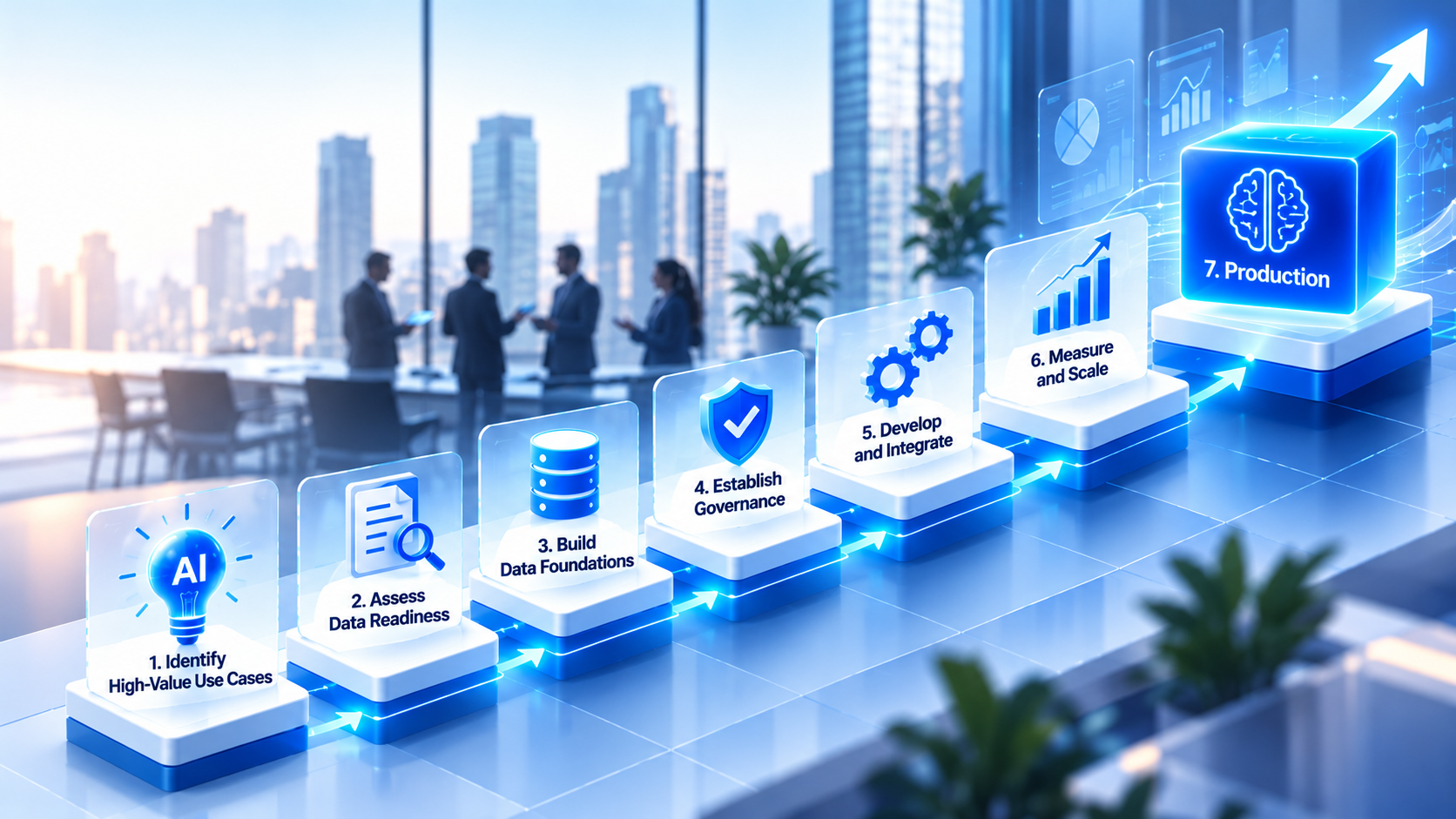
This guide outlines a practical roadmap for moving enterprise AI initiatives from pilot to production while managing risk, controlling costs, and keeping business outcomes at the centre.
Why AI Pilots Often Struggle to Reach Production
A pilot can succeed in a controlled environment because the scope is narrow, data is prepared manually, and a small group of users can work around limitations. Production introduces different expectations: reliable performance, secure access, integration with existing workflows, monitoring, support, and clear accountability.
- Unclear business value. A demo may show that a model can perform a task without proving that it improves a real process.
- Fragmented or poor-quality data. Inconsistent records, disconnected systems, missing context, and unclear ownership can weaken AI outputs.
- Security and privacy gaps. Sensitive information can be exposed through prompts, connected applications, logs, or poorly controlled integrations.
- Limited operational integration. A standalone chatbot may create another destination for employees instead of improving the systems they already use.
- No ownership after launch. Without named owners, monitoring, incident procedures, and a plan for updates, reliability can deteriorate as data and needs change.
The answer is not to avoid experimentation. It is to design pilots with a credible path to production from the beginning.
Step 1: Start With a Business Problem, Not a Model
Begin by identifying a specific business outcome. Strong candidates often involve a recurring process with measurable friction, such as long document-review cycles, slow knowledge retrieval, repetitive service requests, manual data reconciliation, or time-consuming software development tasks.
For each candidate, document the current process, the people affected, the cost of the problem, the expected improvement, and the consequences of an incorrect AI output. Define a baseline and success measures such as cycle time, error rate, employee effort, customer satisfaction, adoption, cost per transaction, or revenue impact.
Prioritise use cases where value is meaningful, the workflow is understood, data access is feasible, and risks can be managed. A high-visibility idea is not necessarily the best first deployment.
Step 2: Assess Data Readiness and Architecture
AI systems depend on the quality, relevance, permissions, and freshness of the information they use. Map the required data sources and determine who owns them, how they are updated, which users or systems can access them, and whether the information can appropriately be used for the intended purpose.
For knowledge-based applications, retrieval-augmented generation (RAG) can help ground responses in approved organisational content. However, RAG is not a substitute for data governance. Document permissions, version control, metadata, retrieval quality, and source freshness still matter. Predictive and analytical use cases also require attention to data lineage, representativeness, and missing or conflicting records.
Architecture decisions should account for identity systems, business applications, APIs, data platforms, and existing security controls. Cloud architecture planning can help establish performance, resilience, and cost requirements.
Related StrategyWiz service: Cloud Architecture & Migration
Step 3: Build Security and Governance Into the Design
Responsible AI is an operational capability, not just a policy document. Define acceptable use, data-handling rules, human review requirements, escalation paths, and the level of autonomy a system is allowed to exercise. Controls should reflect the impact of the use case: an internal drafting assistant does not carry the same risk as a system that influences financial decisions, healthcare workflows, or production infrastructure.
Evaluate identity and access management, encryption, secrets handling, data minimisation, prompt and output risks, third-party dependencies, audit logging, and incident response. Test for prompt injection, unauthorised data retrieval, unsafe tool use, hallucinations, and attempts to bypass policy controls where relevant.
Governance should clarify who approves a use case, who owns the model and data, who can change prompts or connected tools, and how concerns are reported. Record the intended purpose, known limitations, evaluation results, and release approvals.
Related StrategyWiz service: AI Governance & Responsible AI
Step 4: Engineer the Solution for Real Workflows
A production AI solution needs more than a model endpoint. It needs a usable interface, dependable business logic, integration with relevant systems, error handling, and clear boundaries around what the AI can and cannot do. Where an AI system calls tools or performs actions, use scoped permissions, validate inputs, require approval for high-impact actions, and make actions traceable.
For agentic workflows, begin with a well-defined task and a limited set of tools. Establish checkpoints for uncertain or consequential actions, set time and cost limits, and provide a safe way to stop or reverse a workflow. Automate the process around the model as carefully as the model interaction itself.
Software engineering practices remain essential: version control, automated tests, secure code review, environment separation, deployment approvals, rollback procedures, and documentation. Security checks can be integrated into CI/CD pipelines rather than left to a final manual review.
Related StrategyWiz services: AI Application Development | Business Process Automation | DevSecOps & CI/CD
Step 5: Evaluate More Than Accuracy
A model that produces an impressive demonstration can still fail users in day-to-day work. Evaluation should reflect the complete task and consequences of failure. Measure factual correctness, relevance, completeness, latency, availability, usability, and the rate at which people need to correct or reject outputs. For retrieval-based systems, test whether the right source material is found and whether responses accurately reflect it.
Build a representative test set from realistic scenarios, including edge cases and known failure modes. Where appropriate, compare the AI-assisted workflow with the existing process and a non-AI baseline. Use human review for ambiguous or high-impact decisions, and make it easy for users to flag incorrect or unsafe results.
Evaluation should continue after launch. Changes to prompts, models, source data, integrations, or user behaviour can alter performance. A repeatable test suite helps teams detect regressions before they affect users.
Step 6: Pilot in a Controlled Environment, Then Scale in Stages
Choose a pilot group that represents the intended users and workflow. Explain what the system is designed to do, how to verify outputs, what information should not be submitted, and how to report a problem. Collect feedback on usefulness and friction, not just usage counts.
Use stage gates to decide whether to proceed: the solution should meet agreed quality and security thresholds, integrate reliably, have an accountable owner, and demonstrate enough value to justify operating costs. If it misses a threshold, refine the workflow or data, reduce the scope, or stop the initiative. A disciplined decision not to scale a weak use case is also valuable.
After a successful pilot, expand by workflow, team, or business unit. Avoid a broad rollout before support processes, training, access controls, and monitoring are ready.
Step 7: Monitor Cost, Quality, and Business Impact
AI operating costs can include model usage, retrieval and storage, data processing, infrastructure, monitoring, human review, and ongoing engineering. Track cost per successful task rather than looking only at the price of model calls. Caching, model selection, prompt optimisation, batching, and routing simpler tasks to smaller models may help, provided quality and security remain acceptable.
Create a production dashboard that combines technical and business measures. Depending on the use case, monitor response time, availability, error rates, groundedness, user corrections, escalation frequency, cost, adoption, and the target business KPI. Define thresholds that trigger investigation, rollback, or human review.
Review results with both technology and business owners. If the system is technically healthy but does not improve the business process, revisit the use case and workflow rather than assuming that more model capability will solve the problem.
A Practical Enterprise AI Readiness Checklist
- The use case has a named business owner and measurable target outcome.
- The baseline process and success criteria are documented.
- Required data sources, permissions, quality, and ownership have been assessed.
- Security, privacy, governance, and human-review requirements are defined.
- The solution integrates with the systems and workflows users need.
- Evaluation covers realistic scenarios, edge cases, and relevant failure modes.
- Deployment, rollback, support, and incident-response procedures are documented.
- Monitoring covers quality, cost, reliability, adoption, and business impact.
- Employees know how to use the solution and report issues.
- A decision gate exists for scaling, refining, or stopping the initiative.
The Role of a Strategy-to-Execution Partner
Moving AI from pilot to production requires coordinated decisions across business strategy, architecture, engineering, security, and operations. Many organisations have strong capabilities in some of these areas but lack the capacity or shared operating model to connect them. A practical partner can help assess readiness, prioritise use cases, design architecture, implement controls, build integrations, and establish measurements to manage the solution over time.
Moving AI from pilot to production requires coordinated decisions across business strategy, architecture, engineering, security, and operations. Many organisations have strong capabilities in some of these areas but lack the capacity or shared operating model to connect them. A practical partner can help assess readiness, prioritise use cases, design architecture, implement controls, build integrations, and establish measurements to manage the solution over time.
Explore StrategyWiz capabilities: AI Governance & Responsible AI | Cloud & Platform Engineering | Software & Digital Products
Conclusion: Make Production the Plan, Not the Afterthought
Enterprise AI adoption succeeds when organisations connect a meaningful business problem to reliable data, secure architecture, thoughtful governance, production-grade engineering, and continuous measurement. The path does not require every initiative to begin at enterprise scale. It requires each pilot to test both whether AI can help and whether the organisation can operate the solution responsibly.
Enterprises do not need to secure every AI use case in the same way. A phased approach helps prioritize controls according to risk and business value.
Frequently Asked Questions
What is enterprise AI adoption?
Enterprise AI adoption is the process of selecting, integrating, governing, and operating AI capabilities across business workflows, products, and technology systems to achieve defined business outcomes.
How can an organisation move an AI pilot into production?
Define measurable success criteria, validate data readiness, implement security and governance controls, integrate the solution into real workflows, test it against representative scenarios, and establish monitoring and ownership before expanding access.
Why is AI governance important for enterprise AI?
AI governance clarifies acceptable use, accountability, risk controls, human oversight, and monitoring. It helps organisations manage privacy, security, reliability, and compliance risks as AI systems evolve.
How should businesses measure the ROI of AI?
Compare outcomes with a baseline using measures such as time saved, error reduction, cost per successful task, service quality, adoption, revenue contribution, and risk reduction. Include ongoing operating and review costs.
Does every business need to build its own AI model?
No. Many use cases can be addressed by integrating existing models or platforms with business data, workflows, and appropriate controls. Custom model development may be useful when requirements, data, performance, or deployment constraints justify it.