Shadow AI at Work: Why Employees Go Off-Policy and How Organizations Can Respond
Shadow AI at Work: Risks and Governance Strategies | StrategyWiz
Generative AI is becoming part of everyday work. Employees use AI assistants to draft content, summarize documents, analyze information, write code, and accelerate routine tasks. But when those tools are not approved, assessed, or supported by the organization, their use can create a blind spot commonly known as shadow AI.
It is tempting to treat shadow AI as a simple policy violation or assume that employees are experimenting out of curiosity. A recent CASRAI report covering a 2026 study by Nolan Lovett and Mohan Yang points to a more nuanced picture: habitual use and organizational learning conditions appear to matter more than curiosity alone. This has important implications for leaders. Restricting tools without addressing employee needs, access, training, and workplace culture may leave the underlying behavior intact.
For organizations seeking to adopt AI responsibly, the objective should not be to suppress innovation. It should be to make secure, approved AI use practical, understandable, and aligned with business workflows.
What Is Shadow AI?
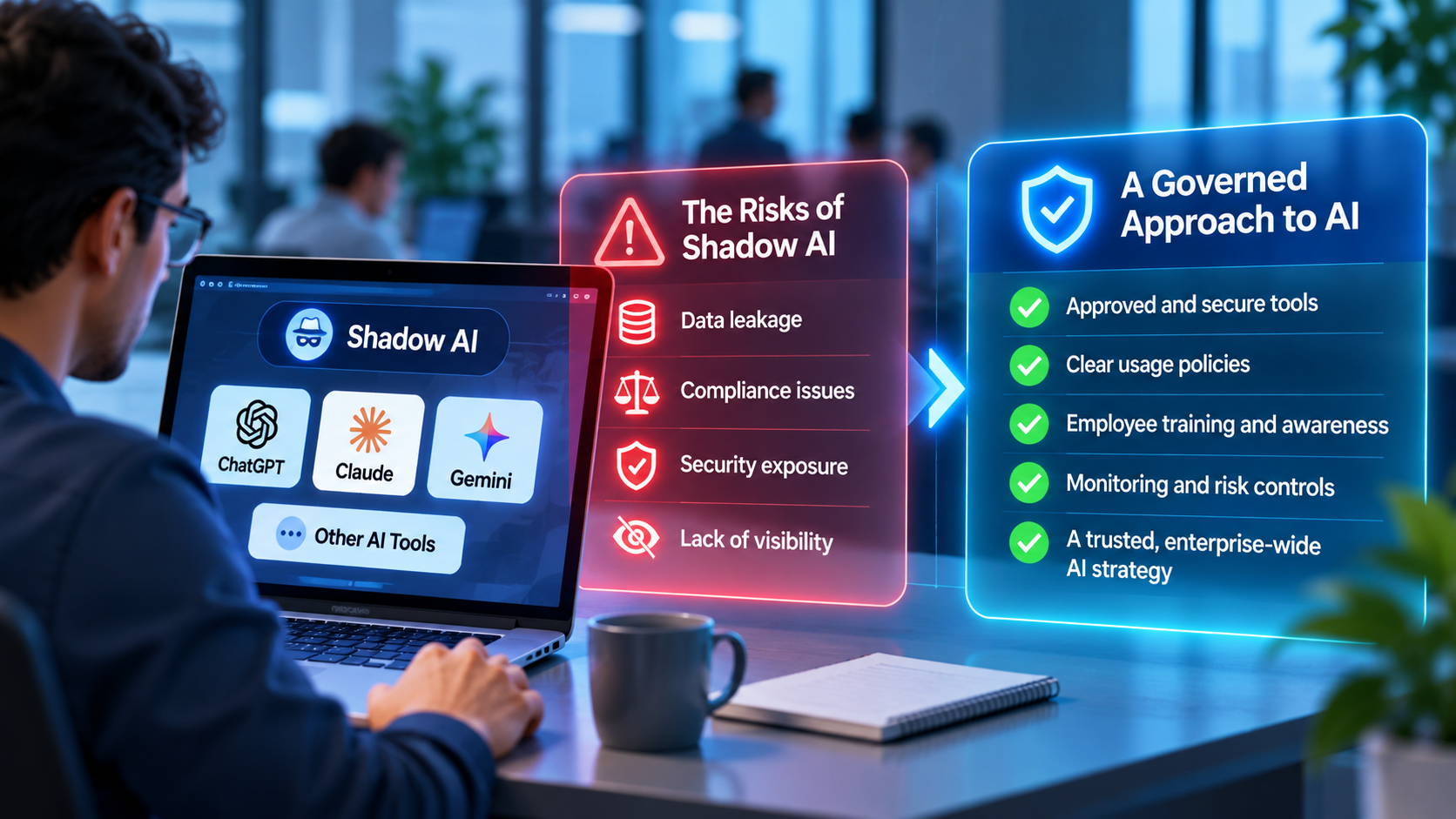
Shadow AI refers to employees using AI tools or services for work without explicit organizational approval, oversight, or established governance. This can include public chatbots, browser-based assistants, AI meeting transcription tools, code-generation services, image generators, and personal subscriptions used to complete workplace tasks.
Shadow AI is not always malicious. In many cases, employees are trying to solve a problem, save time, or compensate for a gap in the tools provided by their employer. However, the absence of organizational visibility can mean that sensitive data is shared with services whose retention, access, security, or contractual terms have not been reviewed.
It is also useful to distinguish unsanctioned use from concealment. An employee may use a tool that has not been approved but openly tell colleagues about it. Another employee may actively hide AI assistance. These are related behaviors, but they are not identical, and an effective response needs to understand both.
What the 2026 Study Suggests About Workplace Shadow AI
The CASRAI report summarizes the study “Beyond Curiosity: Habit and Organizational Learning Capability as Predictors of Shadow AI,” by Nolan Lovett and Mohan Yang. The research analyzed survey responses from 510 employed generative AI users across multiple countries. Its findings challenge the assumption that unsanctioned AI use is mainly driven by individual curiosity.
- Habit was the strongest predictor in the analysis. The study reported that habit accounted for 28.3% of explained variance, while the curiosity dimension called “joyous exploration” contributed 3.4%. The authors found habit dominated curiosity across the model specifications they examined.
- Organizational learning conditions mattered. The organizational learning capability subscales accounted for 24.1% of explained variance. The report highlights experimentation climate and knowledge transfer as important contextual factors.
- Use and concealment were connected but distinct. The study reported that unauthorized use and concealment were moderately correlated, suggesting that organizations should not assume that one behavior fully describes the other.
- Policy without training may be counterproductive. Descriptive comparisons in the report showed higher rates of unauthorized use and concealment in policy-only environments than in training-only environments. This is an association in the sample, not proof that policy itself causes concealment.
The study is cross-sectional and based on self-reported survey data, so its findings should be interpreted as associations rather than causal proof. Even with that limitation, it provides a useful signal: governance needs to address established work habits and organizational conditions, not just employee curiosity.
Why Employees Turn to Unsanctioned AI Tools
Shadow AI often emerges when the speed of employee adoption outpaces the organization’s ability to provide clear guidance and usable alternatives. Common drivers include:
- Workflow friction. Employees may find that approved systems are difficult to access, slow, or disconnected from the tasks they need to complete.
- Capability gaps. Teams may not have approved tools for summarization, research, coding assistance, translation, or analysis.
- Unclear rules. If policies are vague, inconsistent, or hard to interpret, employees may not know which data or tools are acceptable.
- Habit and convenience. Once an AI tool becomes part of a regular workflow, employees may continue using it automatically.
- Fear of judgment. Employees may conceal AI assistance if they believe disclosure will be viewed as a lack of competence or diligence.
- Limited learning and support. Without training, examples, and a safe channel to ask questions, people may learn informally and independently.
The Business Risks of Shadow AI
1. Sensitive data exposure
Employees may paste customer information, personal data, financial details, source code, internal strategy, or confidential documents into external AI tools. Depending on the service and account configuration, that information may be processed or retained in ways the organization has not reviewed.
2. Compliance and contractual concerns
Using an unapproved service can complicate obligations related to privacy, data residency, intellectual property, sector-specific requirements, and customer contracts. Risk depends on the information involved, the tool, the terms, and the organization’s regulatory context.
3. Unverified outputs and decision errors
AI-generated responses can be incomplete, inaccurate, or fabricated. If outputs enter business processes without validation, teams may make decisions based on unreliable information or propagate errors into reports, code, communications, and records.
4. Limited auditability and accountability
When AI usage happens outside approved systems, organizations may lack records of which tool was used, what data was supplied, how an output influenced a decision, or who is responsible for reviewing it.
5. Fragmented technology and cost
Personal subscriptions and overlapping tools can create inconsistent security controls, duplicated spending, and difficulty managing access when employees change roles or leave.
Why a Policy-Only Approach Is Not Enough
A policy is necessary: employees need to understand which tools are permitted, what information must not be shared, and when human review is required. But policy language alone does not create a workable AI environment.
If a sanctioned tool does not meet real workflow needs, employees may continue to rely on familiar alternatives. If employees are afraid to ask questions or disclose their use, organizations may lose the opportunity to identify risks early. Governance is therefore most effective when policy is paired with accessible approved tools, role-based training, technical safeguards, and a culture that encourages transparent learning.
The goal is not to remove accountability. It is to make the responsible path easier to follow than the unapproved one.
A Practical Framework for Reducing Shadow AI
Step 1: Discover where AI is already being used
Start by building a realistic picture of employee usage. Combine surveys, workshops, interviews, procurement reviews, identity and network signals where lawful and appropriate, and feedback from teams. Ask what tasks employees are trying to improve, which tools they use, what data they handle, and what prevents them from using approved options. Keep discovery transparent and proportionate.
Step 2: Create an understandable AI use policy
Define approved tools and use cases, prohibited data categories, disclosure expectations, human-review requirements, and the process for requesting a new tool. Provide examples relevant to different roles. Keep the policy concise enough that employees can apply it in real situations.
Step 3: Provide secure, useful alternatives
Offer approved AI capabilities that meet employee needs, with appropriate identity controls, data protections, and clear usage terms. Provisioning should be responsive: if employees repeatedly request a capability, treat that pattern as input to the AI roadmap rather than only as a compliance issue.
Step 4: Train employees through role-based scenarios
Training should explain how to use approved tools, how to validate outputs, what information should not be entered, and how to escalate uncertain situations. Use practical scenarios for HR, legal, finance, engineering, customer support, and leadership. Reinforce learning over time instead of relying on a one-time awareness session.
Step 5: Embed governance and technical controls
Apply access management, data-loss prevention, logging, vendor assessment, and monitoring according to risk. Where browser-based AI use is in scope, consider controls that can warn users, restrict sensitive actions, or direct them to approved environments. Technical controls should support policy and education, not replace them.
Step 6: Encourage transparent experimentation
Create sanctioned spaces for employees to test AI use cases, share lessons, and discuss failures without stigma. Establish review pathways so promising experiments can be assessed for security, quality, cost, and business value. Knowledge transfer can help turn isolated learning into organizational capability.
Step 7: Measure and continuously improve
Track approved-tool adoption, training completion, tool-request patterns, reported incidents, policy questions, data-risk events, and employee feedback. Interpret metrics carefully: a decline in reported incidents could mean risk has fallen, or that employees are less willing to report. Review controls and guidance as AI products and workflows evolve.
How StrategyWiz Can Help Organizations Govern AI Adoption
Reducing shadow AI requires a joined-up approach across strategy, technology, security, and employee workflows. StrategyWiz Consulting supports organizations in connecting AI adoption goals with governance and implementation capabilities.
AI Governance & Responsible AI: Explore StrategyWiz’s AI governance offering
Organizations can establish use-case oversight, acceptable-use principles, risk assessment practices, accountability, and ongoing governance processes.
Cybersecurity & AI Security: Explore StrategyWiz’s cybersecurity and AI security services
Security controls can help protect sensitive information and improve visibility across AI-enabled workflows, with the scope tailored to the organization’s environment
AI Application Development: Explore AI application development
Purpose-built AI applications and integrations can help teams meet operational needs through approved, governed experiences rather than unmanaged tool usage.
Cloud Architecture & Migration: Explore cloud architecture and migration
A well-designed technology foundation can support secure access, integration, scalability, and operational resilience for enterprise AI services.
Conclusion: Make Responsible AI the Everyday Habit
The emerging lesson from workplace shadow AI research is that organizations should look beyond curiosity and focus on the habits and conditions shaping employee behavior. Employees are more likely to build durable routines around tools that are useful, accessible, supported, and understood.
A sustainable response combines clear policies with training, approved alternatives, governance, security controls, and open organizational learning. Rather than treating every instance of shadow AI as a standalone violation, leaders can use it as a signal: identify the workflow need, evaluate the risk, and create a safer way to accomplish the task.
The organizations best positioned for responsible AI adoption will be those that make transparency and secure usage part of how work gets done.
Frequently Asked Questions
What is shadow AI in the workplace?
Shadow AI is the use of AI tools for work without explicit organizational approval, oversight, or governance. It can include public chatbots, AI meeting assistants, coding tools, and personal subscriptions.
Why do employees use shadow AI?
Employees may use unsanctioned AI because it is convenient, helps complete work faster, fills capability gaps, or is already part of a habitual workflow. Unclear policy and limited training or access can also contribute.
What are the main risks of shadow AI?
Risks may include sensitive data exposure, privacy and contractual issues, inaccurate outputs, limited auditability, inconsistent security controls, and unmanaged costs.
How can organizations reduce shadow AI?
Organizations can discover current usage, publish clear policies, provide approved tools, train employees by role, implement proportionate technical controls, encourage transparent experimentation, and measure outcomes.
Is banning AI tools enough to stop shadow AI?
A ban may restrict certain tools, but it does not necessarily address the workflow needs or habits that led employees to use them. Policies are more effective when paired with practical approved alternatives and training.
How does AI governance help manage shadow AI?
AI governance establishes accountability, acceptable-use rules, risk assessment, human oversight, tool approval, and monitoring. It helps organizations make AI adoption more consistent and manageable.
Sources and Further Reading
- CASRAI: Workplace Shadow AI: Habit & Learning Study 2026
- Lovett & Yang: Beyond Curiosity: Habit and Organizational Learning Capability as Predictors of Shadow AI (arXiv)
- Lovett & Yang: Research article in Computers in Human Behavior
- UK National Cyber Security Centre: The Hidden Risks of Shadow AI
- NIST: AI Risk Management Framework