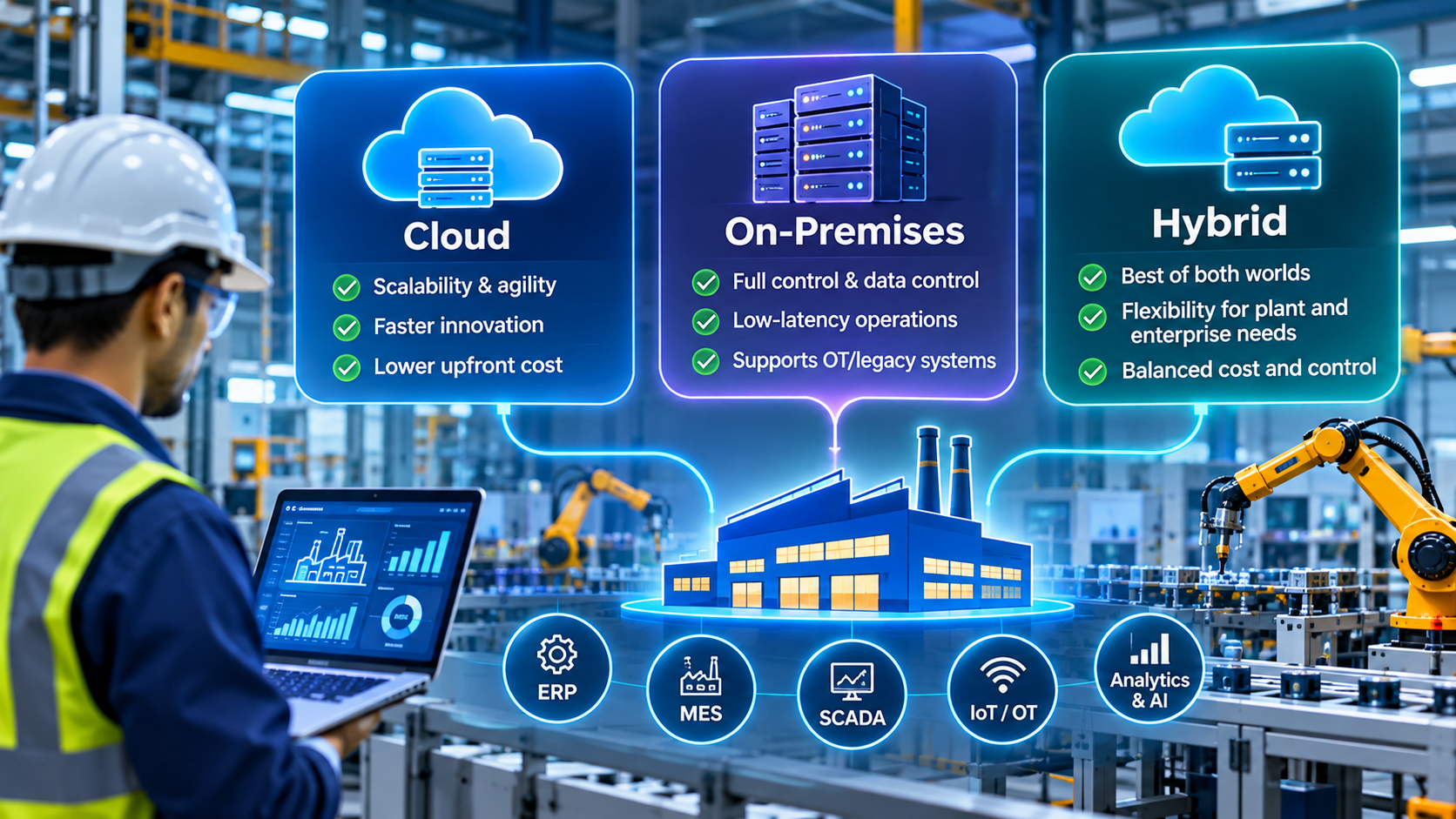
Cloud, On-Premises, or Hybrid? Choosing the Right Enterprise Application Deployment Model for Manufacturers in 2026
Cloud vs On-Prem vs Hybrid for Manufacturers in 2026 | StrategyWiz
Manufacturers are modernizing enterprise applications while balancing production continuity, plant connectivity, cybersecurity, cost, and changing business requirements. Cloud platforms offer scalability and managed services. On-premises environments can provide local control and predictable connectivity for critical operations. Hybrid architectures combine both, but introduce integration and governance responsibilities.
So which deployment model is best for manufacturing in 2026? There is no universal answer. The right approach depends on the application, plant environment, data sensitivity, latency, resilience requirements, modernization goals, and the organization’s ability to operate the architecture. Rather than selecting one model for every system, manufacturers should evaluate workloads individually.
Why Deployment Strategy Matters in Manufacturing
All manufacturing applications do not operate under the same conditions. Corporate finance, customer portals, engineering systems, production planning, warehouse operations, and plant-floor systems have different availability, integration, and performance requirements. A disruption to a production system can affect equipment, line schedules, product quality, and plant output.
Manufacturers also operate with long-lived equipment, specialized systems, supplier connections, and plant-specific processes. Moving everything to cloud without understanding dependencies can create unnecessary risk. Keeping everything on-premises, however, can limit scalability, remote access, modernization, and newer analytics or AI capabilities.
Cloud Deployment: Best for Agility, Scale, and Modern Services
Cloud deployment uses provider-managed infrastructure and services to host applications, data, and computing resources. For manufacturers, cloud can support enterprise systems, analytics, collaboration, application development, supplier portals, and selected production-support workloads.
Where cloud can fit well
- ERP and business applications where cloud functionality meets process and regulatory requirements
- Customer, supplier, and partner portals with variable demand
- Analytics, data platforms, reporting, and AI workloads
- Development and testing environments needing rapid provisioning
- Multi-site applications benefiting from centralized access and managed services
Benefits
- Scale resources as demand changes without purchasing all infrastructure upfront
- Access managed services, platform updates, and newer capabilities
- Support distributed teams, facilities, and business partners
- Reduce some infrastructure maintenance through provider-managed services
Manufacturing considerations
Cloud-connected operations depend on reliable network connectivity, well-designed integration, identity controls, and recovery plans. Cloud does not automatically guarantee lower cost or higher security. Subscription, data transfer, integration, monitoring, and ongoing service costs need to be included. Cloud is often a strong choice when an application can tolerate the connectivity model, data and compliance requirements are met, and managed capabilities or easier scaling are valuable.
On-Premises Deployment: Best for Specific Control and Operational Needs
On-premises applications run on infrastructure owned or directly managed by the organization, usually in its own data center or facility. This model can remain useful for manufacturing environments with specialized equipment, constrained connectivity, strict local control requirements, or systems difficult to modernize without significant redesign.
Where on-premises can fit well
- Plant applications requiring local operation during network interruptions
- Legacy systems with tightly coupled machine, control, or proprietary integrations
- Workloads with specific hardware, configuration, or local data requirements
- Systems where the organization has strong internal operations and infrastructure teams
Benefits
- Direct control over infrastructure, configurations, and maintenance windows
- Local access for selected plant systems
- Preserve established integration patterns while modernization is planned
- Support specialized equipment or environments that cannot easily be moved
Manufacturing considerations
On-premises environments require ongoing investment in hardware refreshes, patching, backups, capacity planning, physical security, disaster recovery, and specialist staffing. Local control should not be confused with security by default. Poorly segmented, outdated, or inadequately maintained systems can still create significant risk. Include a long-term support and modernization plan.
Hybrid Deployment: A Practical Path for Many Manufacturers
Hybrid deployment connects cloud services with on-premises systems. It is often practical for manufacturers because business applications and plant environments may modernize at different speeds. A company can move selected enterprise functions to cloud while retaining local execution for systems that require proximity, specialized integrations, or continued operation during connectivity disruptions.
Common hybrid manufacturing patterns
- Cloud enterprise applications connected to plant-level MES, SCADA, or historian systems
- Centralized data and analytics with local data collection or processing at facilities
- Cloud ERP or planning integrated with local manufacturing and quality systems
- Cloud collaboration and reporting while selected workloads remain plant-side
- Edge processing that filters, buffers, or responds to operational data before sending information to cloud
Benefits and trade-offs
Hybrid can enable staged modernization, keep latency-sensitive workloads close to operations, use cloud scalability for analytics and business systems, and balance central standards with plant-level requirements. However, it can create more moving parts: identity across environments, integration maintenance, data synchronization, network dependencies, monitoring, incident ownership, and duplicated operational skills. It works best when systems of record, data flows, security, and ownership are clearly defined.
Cloud vs On-Premises vs Hybrid: Manufacturing Comparison
Factor | Cloud | On-premises | Hybrid |
Scalability | Elastic services | Capacity planned internally | Scale cloud while retaining local capacity |
Plant connectivity | Connectivity and fallback design matter | Local access can be easier | Local operations plus cloud connectivity |
Latency-sensitive tasks | Evaluate carefully; edge may help | Can suit local real-time needs | Local processing with cloud coordination |
Control | Shared responsibility | Direct infrastructure control | Responsibilities split |
Maintenance | Managed components; customer still secures apps | Customer manages lifecycle | Shared operations and coordination |
Cost | Subscription/consumption and data costs | Capital, maintenance, staffing | Mixed costs plus integration overhead |
Modernization | Managed services and quicker provisioning | Can preserve legacy constraints | Phased transformation |
Fit | Scalable, managed workloads | Specific control-dependent workloads | Mixed environments and transition roadmaps |
Which Model Is Best for Different Manufacturing Workloads?
ERP, finance, procurement, and corporate workflows
Cloud is a strong candidate when the application meets integration, compliance, customization, and operational requirements. Hybrid may be needed where plant or legacy systems remain tightly connected.
MES, production execution, and shop-floor coordination
Evaluate latency, local availability, plant connectivity, equipment integration, and outage behavior. Hybrid or local deployment may fit depending on the specific system.
SCADA, machine control, and time-sensitive operations
Keep real-time control requirements and safety boundaries central. Do not move control functions to cloud solely because cloud is the strategic direction; assess with OT engineering and security teams
Analytics, AI, and predictive maintenance
Cloud can provide scalable analytics and AI services, while edge or local processing may address connectivity, response time, or data volume constraints. Data quality and integration are critical
Supplier portals, customer applications, and collaboration
Cloud often suits external access and scaling, provided identity, security, and data protection are designed properly
Legacy plant applications
On-premises may remain necessary temporarily. Hybrid integration and a modernization roadmap can reduce indefinite dependence on unsupported systems
7 Questions Manufacturers Should Ask Before Choosing a Deployment Model
- Does this application directly affect production, quality, safety, or plant uptime?
- What latency, connectivity, and offline operating requirements exist at each facility?
- Which data is sensitive, regulated, contractually restricted, or location-bound?
- How does it connect to ERP, MES, SCADA, historians, warehouses, and suppliers?
- Who will operate, patch, monitor, secure, back up, and recover the application?
- What is the five-year total cost, including subscriptions, infrastructure, network, integration, staffing, downtime risk, and exit costs?
- Can it be migrated in phases, and what are rollback and continuity plans?
A Decision Framework: Choose Per Workload, Not by Trend
Classify the workload: Document business criticality, users, process dependencies, data types, and production impact.
Define constraints: Identify latency, offline requirements, regulation, security, customization, and integration needs.
Compare viable models: Evaluate cloud, on-premises, and hybrid against requirements that matter for this workload.
Build a five-year cost and risk view: Include licensing, cloud consumption, hardware, support, integration, migration, downtime exposure, and skills.
Pilot a representative workload: Validate performance, security, resilience, user experience, integration, and support assumptions.
Create a roadmap: Sequence migrations, standardize interfaces and data, document ownership, and plan legacy retirement.
The 2026 Recommendation for Manufacturers
For many manufacturers, hybrid is a practical operating reality and a useful modernization strategy, but it should not become the default for every application. Cloud is compelling for applications that benefit from managed services, scale, faster provisioning, and access to modern analytics or AI. On-premises remains relevant for workloads with clear local-control, latency, equipment, connectivity, or other constraints.
Build a workload-based architecture: move cloud-ready applications where the business case is clear, keep operationally constrained workloads close to the plant where needed, and connect environments through secure, well-governed integration. Review deployment choices as processes, equipment, regulations, and technology evolve. The goal is not cloud-first or on-premises-first at any cost. It is business-fit, resilient, secure, and ready for modernization.
How StrategyWiz Supports Manufacturing Modernization
Plan workloads, migration paths, integration patterns, and cloud foundations aligned with business and technical requirements.
Develop and modernize application experiences and workflows to support business goals and evolving operational needs. StrategyWiz can help assess application landscapes, identify modernization opportunities, and plan deployment approaches balancing innovation, continuity, security, and long-term cost.
Frequently Asked Questions
Sources and Further Reading